
Growth isn't Free
Are we building communities, or are we building rooftops?

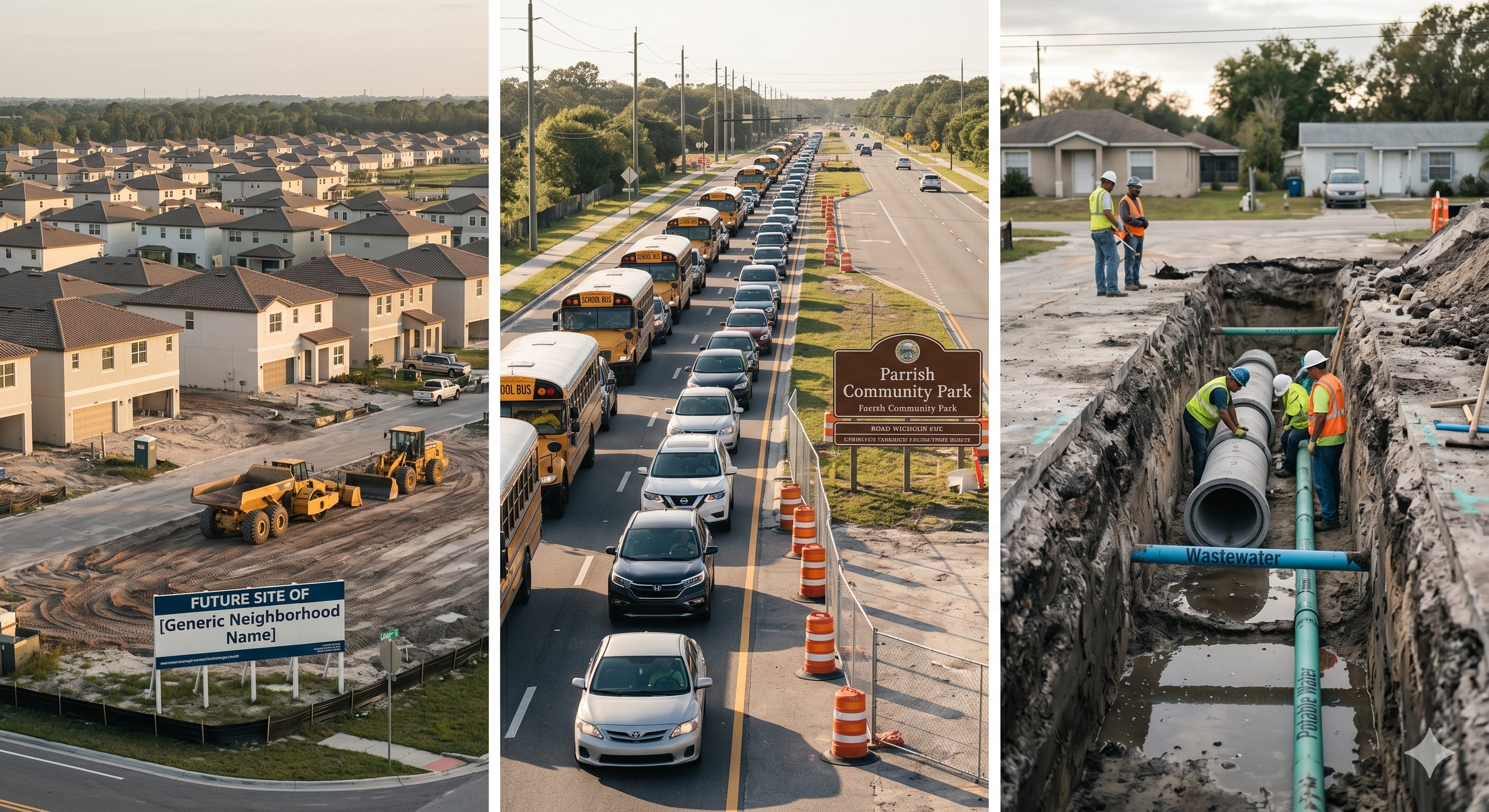
Image by Gemini
Growth requires more than houses. It requires roads, schools, parks, public safety, water, wastewater systems, and long-term planning. So who pays for it all?
If Manatee County continues growing as planned, who pays for everything that growth requires?
New residents need roads.
They need schools.
They need parks.
They need libraries.
They need law enforcement.
They need fire protection.
They need drinking water.
They need wastewater treatment.
They need stormwater systems.
None of those things appear by magic.
Someone pays.
The Promise
Throughout the Comprehensive Plan, the County repeatedly emphasizes that growth should occur where infrastructure can support it.
On paper, that sounds reasonable.
The idea is that development should follow infrastructure rather than infrastructure constantly struggling to catch up with development.
The question residents should ask is:
Has that happened?
Or has infrastructure been playing catch-up for years?
What Residents Experience
Most residents don't read planning documents.
They experience growth differently.
They experience it sitting in traffic.
They experience it when schools become crowded.
They experience it when flooding worsens.
They experience it when emergency response times increase.
They experience it when roads that once worked no longer function during rush hour.
Those experiences are often the first indication that infrastructure may not be keeping pace with development.
Impact Fees: The Growth Pays for Growth Theory
One of the primary tools local governments use is impact fees.
The theory is simple.
New development creates demand for infrastructure.
New development should help pay for the infrastructure needed to support that growth.
Impact fees may contribute toward:
Roads
Schools
Libraries
Parks
Public safety facilities
The goal is to avoid shifting all growth-related costs onto existing residents.
The challenge, however, is that impact fees rarely cover every long-term cost associated with growth.
[and for a long time we didn't collect it]
Infrastructure must also be operated, maintained, repaired, and eventually replaced.
The Question I Keep Coming Back To
As I read through these documents, I find myself asking the same question over and over:
Are we building communities, or are we building rooftops?
Housing is important.
But communities require more than homes.
They require services.
Amenities.
Employment opportunities.
Transportation options.
Recreation.
Environmental protection.
And infrastructure capable of supporting the people who live there.
District 1 and the Growth Conversation
This question feels especially relevant in District 1.
The North River area continues to experience tremendous growth.
New neighborhoods appear almost overnight.
Yet many residents continue asking the same questions:
Where are the roads?
Where are the services?
Where are the amenities?
Where is the infrastructure that was supposed to accompany the growth?
Those questions deserve answers.
My Takeaway
Growth itself is not the issue.
Poorly planned growth is.
The Comprehensive Plan contains many references to infrastructure planning, concurrency, service levels, and growth management.
The challenge is not writing those policies.
The challenge is implementing them.
As I continue reading, I'm becoming increasingly convinced that the real debate is not whether Manatee County will grow.
It will.
The real debate is whether infrastructure, services, and quality of life will keep pace with that growth.
That may ultimately be one of the most important questions facing our county.
As always, I'm not a planner or policy expert. I'm simply a curious resident reading the Comprehensive Plan, translating what I learn into plain English, and sharing my observations.
Trust but verify.
Well done Sari. The current proposal to cut property taxes shows what we are in for. Our quality of life will continue to decline unless we are prepare to pay what it takes to maintain or even improve it.