
Hyperscale
What AI datacenters are, how they work, and why communities are debating them

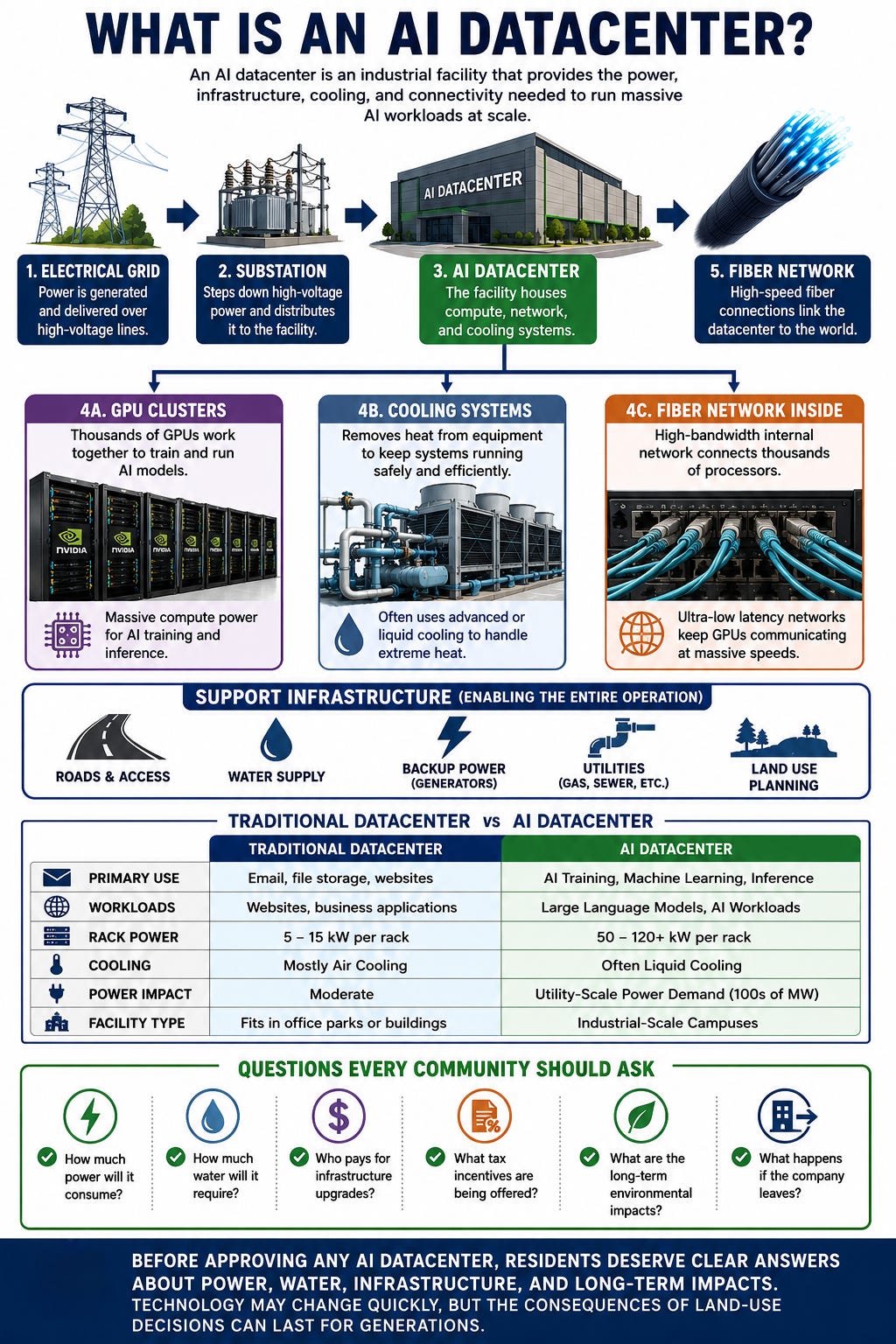
I’ll start with a confession.
I like technology.
For nearly forty years, I’ve worked in information technology, infrastructure, security, and cybersecurity. I’ve built networks, managed systems, recovered from disasters, written policies, secured environments, and spent more hours in datacenters than I could possibly count.
I also use artificial intelligence almost every day.
So if you’re expecting this article to be an attack on technology or AI, it’s not.
That said, AI does raise some legitimate concerns about privacy, surveillance, intellectual property, and how it may change the workforce. Those are important conversations.
But this article isn’t about AI itself.
This article is about the massive physical infrastructure required to support AI.
The buildings.
The land.
The power.
The water.
The cooling systems.
The zoning.
The things most people never see when they open ChatGPT, ask Alexa a question, or use an AI image generator.
Recently I’ve heard terms like “technology center,” “innovation campus,” and “AI infrastructure” used in discussions around the country and even here in Florida.
Those phrases sound fairly harmless.
The reality can be much more complicated.
What Is a Hyperscale AI Datacenter?
Most people have heard the term datacenter.
Traditionally, datacenters housed the servers that run things like:
• Email
• Websites
• Online banking
• Cloud storage
• Business applications
• Government systems
Those facilities still exist.
A hyperscale AI datacenter is something different.
Think of it less as a giant computer room and more as a factory that produces computation.
These facilities contain thousands—and sometimes tens of thousands—of specialized computer processors working together around the clock.
Those processors are called GPUs, or Graphics Processing Units.
The name comes from their original purpose: rendering graphics and video.
It turns out they are also exceptionally good at performing the massive calculations required by artificial intelligence.
Today, GPUs have become the engines that power AI.
And modern AI requires a lot of them.
Why Does AI Need So Much Infrastructure?
Imagine one person trying to solve a million math problems.
Now imagine ten thousand people solving those problems at the same time.
That is essentially what a hyperscale AI datacenter is doing.
Thousands of GPUs working simultaneously.
The challenge is that those GPUs consume enormous amounts of electricity and generate enormous amounts of heat.
Which brings us to the first major issue.
Power
AI doesn’t run on magic.
It runs on electricity.
Lots of electricity.
Some of the largest AI datacenters being proposed around the world require hundreds of megawatts of power.
For perspective, that can rival the electricity consumption of small cities.
That means:
• New substations
• Transmission upgrades
• Utility infrastructure
• Backup power systems
The question isn’t simply whether a building can be constructed.
The question becomes whether the surrounding infrastructure can support it.
Cooling
When people hear that datacenters require cooling, they often imagine air conditioning for the building.
That’s not really the primary challenge.
The challenge is cooling the GPUs themselves.
The chips generate so much heat that traditional air cooling is becoming less effective.
Many modern AI facilities now use liquid cooling systems.
In some cases, liquid circulates directly through cooling plates attached to the processors, carrying heat away from the chips before they overheat.
In other words, the cooling system exists primarily because of the processors.
No GPUs.
No AI.
No cooling problem.
Water
This is where things get interesting for Florida.
Different cooling systems use different amounts of water.
Some consume very little.
Others can consume significant quantities depending on their design.
As AI facilities become larger, communities naturally begin asking questions.
Where will the water come from?
What happens during drought conditions?
How does this fit into long-term water planning?
Those aren’t anti-technology questions.
They’re planning questions.
Why Are Companies Building These Facilities?
The answer is simple.
Demand.
Every AI chatbot.
Every AI image generator.
Every recommendation engine.
Every large language model.
They all require computing power somewhere.
The race to build AI is creating a race to build the infrastructure behind AI.
The technology is real.
The demand is real.
The question is where that infrastructure should go.
Why Is Zoning Becoming Such a Big Deal?
This may be the most important issue that most people have never heard of.
Many local zoning codes were written long before hyperscale AI datacenters existed.
As a result, these facilities are often proposed under categories such as:
• Technology Center
• Research and Development
• Business Park
• Light Industrial
The problem is that when residents hear “technology center,” they often picture office buildings filled with programmers.
What they may not picture is a facility consuming hundreds of megawatts of electricity and requiring industrial-scale cooling infrastructure.
That’s why communities across the country are beginning to revisit how datacenters are classified and regulated.
The question isn’t whether technology should exist.
The question is whether existing zoning categories accurately describe what is being proposed.
What About Florida?
Florida is unique.
We have rapid population growth.
We have increasing demands on infrastructure.
We have concerns about water supply.
We have heat.
We have hurricanes.
We have environmental resources worth protecting.
Those realities don’t automatically mean hyperscale AI datacenters should never be built here.
But they do mean communities should ask hard questions before approving them.
Why I Keep Coming Back to Port Manatee
Ports are strategic assets.
They support commerce.
Transportation.
Manufacturing.
Logistics.
Economic development.
The question is not whether a datacenter can physically be located near a port.
The question is whether utility-scale AI infrastructure is the highest and best use of limited port-adjacent industrial land.
That’s a land-use question.
It’s a planning question.
And it’s a question worth discussing openly before decisions are made.
My Take
I am not opposed to technology.
I am not opposed to artificial intelligence.
I use AI.
I understand why companies are investing billions of dollars into it.
What concerns me is whether communities fully understand what they are being asked to approve.
A hyperscale AI datacenter is not simply a “technology center.”
It is major infrastructure.
It affects power planning.
Water planning.
Land-use planning.
Economic development planning.
And potentially the future character of a community.
Whether you support them or oppose them, the first step is understanding what they are.
Because good decisions start with good information.
And that’s exactly why I started sharing about this this topic
Yes — this is exactly the kind of “how we fix it” section your article needs.
You can frame it like this:
How We Fix It Before It Becomes a Done Deal
If Manatee County does not want hyperscale AI data centers at or around Port Manatee, then the Comprehensive Plan and Land Development Code need to say that clearly.
Right now, the danger is not only what the plan says. The danger is what it does not say.
Broad words like technology, light industrial, logistics, warehouse, port-compatible development, economic development, utility infrastructure, or mixed use can become loopholes.
A hyperscale AI data center may not arrive wearing a sign that says, “I am an AI data center.” It may be presented as a technology facility, infrastructure investment, industrial use, or economic development project.
That is why definitions matter.
The County should clearly define large-scale data centers, hyperscale AI data centers, high-load computing facilities, and similar uses in both the Comprehensive Plan and Land Development Code.
Then the County should clearly state where those uses are prohibited, especially in sensitive or high-impact areas such as Port Manatee, the Port Encouragement Zone, coastal areas, conservation-adjacent areas, and places where water, power, traffic, stormwater, flooding, emergency response, or hurricane resilience are already serious concerns.
The County should also make clear that these facilities cannot simply be treated as light industrial, warehouse, logistics, office, technology, or public utility uses by default.
If an applicant wants to build one, they should have to come through a full public process. That should include a Comprehensive Plan amendment, rezoning if needed, public hearings, mailed notice, and independent review of water use, power demand, wastewater, stormwater, generator emissions, noise, heat, flooding, emergency access, environmental impacts, and taxpayer cost.
Most importantly, the burden should be on the applicant to prove the project will not shift costs or risks onto residents.
This is not anti-technology. This is basic planning.
A Comprehensive Plan is supposed to protect the public interest before the crisis arrives. If the County leaves vague language in place, then residents may only find out what was allowed after the project is already moving forward.
So the fix is simple:
Define it.
Map it.
Limit it.
Prohibit it where it does not belong.
Require public hearings before any loophole becomes a land-use entitlement.
Because if hyperscale AI data centers are not clearly prohibited in the wrong places, then they may be allowed by omission.
Help me get on the ballot for Manatee BoCC District 1.
Only 3 more days to collect the qualifications fee, please chip in

This is an excellent, understandable explanation of a complex issue. Well done.
Je suis très contente avec tes idées 💡!
J’habite à Stockholm
La 🇸🇪!
Bonne chance aujourd’hui!!